miércoles, 31 de agosto de 2016

Put no one out of your heart - Rick Hanson

Just One Thing
Simple practices for more happiness, love, and wisdom

What is an open heart?
The Practice:
Put no one out of your heart.
Why?
We all know people who are, ah, . . . challenging. It could be a critical parent, a bossy supervisor, a relative who has you walking on eggshells, a nice but flaky friend, a co-worker who just doesn't like you, a partner who won't keep his or her agreements, or a politician you dislike. Right now I'm thinking of a neighbor who refused to pay his share of a fence between us.

As Jean-Paul Sartre put it: "Hell is other people."

Sure, that's overstated. But still, most of a person's hurts, disappointments, and irritations typically arise in reactions to other people.

Ironically, in order for good relationships to be so nurturing to us as human beings - who have evolved to be the most intimately relational animals on the planet - you must be so linked to others that some of them can really rattle you!

So what can you do?

Let's suppose you've tried to make things better - such as taking the high road yourself and perhaps also trying to talk things out, pin down reasonable agreements, set boundaries, etc. - but the results have been partial or nonexistent.

At this point, it's natural to close off to the other person, often accompanied by feelings of apprehension, resentment, or disdain. While the brain definitely evolved to care about "us," it also evolved to separate from, fear, exploit, and attack "them" - and those ancient, neural mechanisms can quickly grab hold of you.

But what are the results? Closing off doesn't feel good. It makes your heart heavy and contracted. And it primes your brain to be more tense and reactive, which could get you into trouble, plus trigger the other person to act worse than ever.

Sometimes you do have to hang up the phone, block someone on Facebook, turn the channel on TV, or stay at a motel when visiting relatives. Sometimes you have to put someone out of your business, workgroup, holiday party list - or bed.

In extreme situations such as abuse, it may feel necessary to distance yourself utterly from another person for awhile or forever; take care of yourself in such situations, and listen to that inner knowing about what's best for you. But in general:

You never have to put anyone out of your heart.
How?
When your heart is open, what's that feel like? Physically, in your chest - like warmth and relaxation - and in your body altogether. Emotionally - such as empathy, compassion, and an even keel. Mentally - like keeping things in perspective, and wishing others well.

Feel the strength in being openhearted, wholehearted. Be not afraid, and be of good heart. Paradoxically, the most open person in a relationship is usually the strongest one.

Get a sense of your heart being expansive and inclusive, like the sky. The sky stays open to all clouds, and it isn't harmed by even the stormiest ones. Keeping your heart open makes it harder for others to upset you.

Notice that an open heart still allows for clarity about what works for you and what doesn't, as well as firmness, boundaries, and straight talk. Mahatma Gandhi, Nelson Mandela, and the Dalai Lama are famous for keeping their hearts open while also being very effective.

Seeing all this, make a commitment to an open heart.

In this light, be mindful of what it feels like - physically, emotionally, mentally - to have your heart closed to a particular person. Be aware of the seemingly good reasons the reactive brain/mind throws up to justify this.

Then ask yourself, given the realities of this challenging person, what would have been a better path for you? For example, maybe you should have gotten more support from others or been more self-nurturing, so you wouldn't have been as affected. Or spoken up sooner to try to prevent things from getting out of hand. Or managed your internal reactions more skillfully. Maybe you've done some things yourself to prompt the other person to be difficult. Whatever these lessons are, there's no praise or blame here, just good learning for you.

And now, if you're willing, explore opening your heart again to this person. Life's been hard to him or her, too. Nothing might change in your behavior or in the nature of the relationship. Nonetheless, you'll feel different - and better.

Last, do not put yourself out of your heart. If you knew you as another person, wouldn't you want to hold that person in your heart?


Just one thing that could change your life.
(© Rick Hanson, 2016)

sábado, 27 de agosto de 2016

Photoespaña: Miroslav Tichy, la mirada del caminante


Aunque empezó su carrera artística como pintor pronto abandonó la pintura (en protesta por los cambios políticos que tuvieron lugar en Praga con la invasión soviética ) para dedicarse a retratar a las mujeres que veía en su callejeo diario cuando salía de las cárceles y las instituciones para enfermos mentales.

En muchas ocasiones vemos que ellas actúan con toda naturalidad, como si no le hubieran visto, probablemente pensando que esa vieja cámara que aquel hombre llevaba (y que él mismo había fabricado con materiales de desecho) no servía para nada… Esta imagen  es una de las pocas en las que la persona retratada mira al fotógrafo checo.

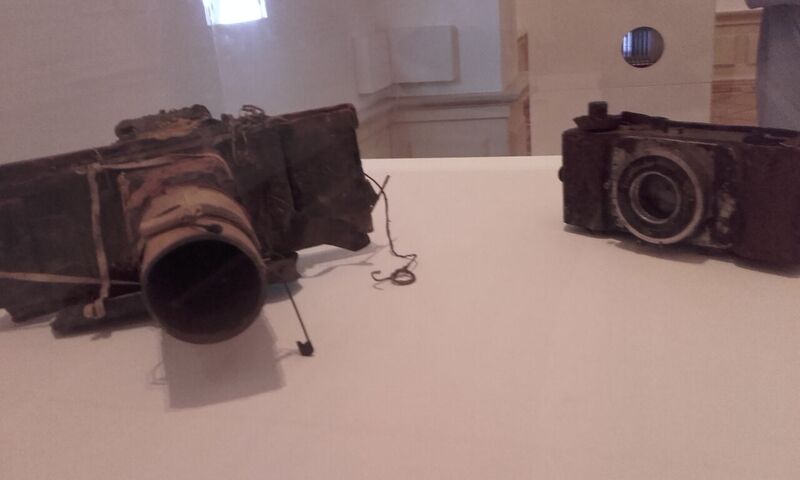
 Y abajo podemos ver dos de las cámaras que utilizaba, creadas por él, de forma totalmente artesanal. Este hombre que vivió siempre solo y a contracorriente se definía a sí mismo irónicamente como un "Tarzán jubilado" y no quiso nunca vender sus fotografías ni se dejó impresionar por el éxito que tuvieron en los últimos años de su vida cuando empezó a ser reconocido como un artista con una mirada especial. 


jueves, 25 de agosto de 2016

miércoles, 24 de agosto de 2016

Museo Arqueológico Alcalá Henares


Caballero necrópolis ibérica Los Villares
490 a.C.
Albacete


domingo, 21 de agosto de 2016

Cauchemars, rêves - La historia del caballero Tondal y la escuela del Bosco


« La part la plus débridée de nous-même qui s’exprime dans le rêve est extrêmement affolante.

 Que ce soit le cauchemar, les rêves érotiques ou les rêves de renversement de situation, ce sont chaque fois des chocs que la conscience tamise par des formes de censure. L’emprise de la raison, ici en Occident, sur notre rapport au langage et à la raison établit une chape de plomb dans l’ordre de ce qui est représentable et imaginable, dans le rapport à soi-même, où des règles très strictes de décence définissent ce qui est supportable pour le sujet.
Or le rêve ne cesse de bouillir et de déborder. Attribué à Hécate dans l’Antiquité païenne, l’une des trois déesses de la lune associée à l’ombre et aux morts, au grand Transgresseur diabolique dans la tradition chrétienne, le cauchemar permet, en peinture, dans un siècle très ordonné religieusement, de transgresser toutes les règles sous couvert de représenter l’enfer.

« Nous n’en avons jamais fini avec le travail du négatif »

Jérôme Bosch et ses disciples sont ainsi autorisés à représenter tous les phantasmes de cruauté, toutes les figures de transgression présadiennes et spécifiquement humaines. Ils rappellent que nous n’en avons jamais fini avec le travail du négatif. Le cauchemar n’est jamais totalement « intégrable ». Il ne cesse de créer de l’inquiétude, de nourrir une rupture, de créer des fractures dans nos vies en déplaçant l’ordre qu’on espère leur attribuer.
Herry de Patinir, rarement exposé, dépeint au XVIe siècle, dans un Paysage avec la Tentation de Saint Antoine, un incendie particulièrement beau où sont concentrées toutes les thématiques des tentations qui permettent à la fois de mettre en image ce soubassement freudien de nos phantasmes et, en même temps, de transgresser un ordre social. Ces puissances merveilleuses et terrifiantes du désir et de l’excès ne cessent de se dérober à toute tentative d’intégration : le rêve dessine un paysage intérieur en flamme animé par des incendies nocturnes que seul le jour parvient à apaiser. »


http://www.philomag.com/les-idees/cauchemars-debordements-et-transgression-le-travail-du-negatif-8632


En la madrileña Fundación Lázaro Galdiano se encuentra el cuadro de un pintor de la escuela del Bosco que ilustra la historia del caballero Tondal, que viajó durante un sueño que duró tres días el cielo y el infierno y que al despertar decidió dedicarse a una vida piadosa muy distinta de la que había llevado hasta ese momento.

El autor de ese relato, un monje irlandés llamado Marcus fue probablemente conocido por Dante cuando escribió la Divina Comedia. 

viernes, 19 de agosto de 2016

El cielo de Agosto - Mario Viciosa y el pronóstico del cielo.


Las despedidas siempre son un poco tristes y a partir de este mes dejaremos de ver las presentaciones (con el título de "El pronóstico del cielo" ) que Mario Viciosa hacía cada mes desde el Planetario de Madrid desde hace ya unos años. Mucho más divertido que el hombre (o la mujer) "del tiempo"por sus efectos especiales, la música, lo accesible que hace un tema complejo y lejano para los que no somos expertos en Astronomía...

 No olvidaremos su profesionalidad y su simpatía y esperaremos verle en este o en otro programa por el estilo muy pronto.


Aquí dejo un enlace sobre el cielo de Agosto, las Perseidas y mucho más…el último programa.


http://www.elmundo.es/ciencia/2016/08/02/579b4736e5fdea977c8b45ce.html


Yoga a la sombra


Hoy hace mucho calor para salir a la calle. Pero unos ejercicios de yoga en casa, a tu ritmo sí que están al alcance del que quiera y tenga un rato de tranquilidad, sin mucho ruido alrededor…El instructor de esta clase on line es Joaquín Castaño.